
News
News
Recently, the research team led by Associate Professor Baowen Zhou from School of Mechanical Engineering, SJTU, under the guidance of Academician Zhen Huang's group, has made significant progress in efficient and stable hydrogen production from liquid hydrogen carriers via heterogeneous catalysis driven by industrial waste heat. Their research achievement, titled "Highly efficient heterogeneous thermal catalysis for noble-metal-free hydrogen production from formic acid," has been published in Nature Communications. Ph.D. student Liang Qiu from the Institute of New Energy and Power at School of Mechanical Engineering is the first author of the paper. Co-corresponding authors include Associate Professor Baowen Zhou, Associate Professor Lin Yao from the China-UK Low Carbon College at Shanghai Jiao Tong University, Assistant Professor Ping Wang from Peking University, and Associate Researcher Zhiwei Jiang from Sun Yat-sen University.
Liquid Hydrogen Carriers (LHCs) can leverage the mature infrastructure of fossil fuels to provide a new solution for addressing the challenges of hydrogen storage and transportation. Formic acid has emerged as a research hotspot due to its advantages such as non-toxicity, low flammability, and high hydrogen storage density. Heterogenous catalysis is well-suited for industrial applications because of its merits of reusability, structural stability, and ease of scaling up. However, current technologies are highly dependent on noble-metal catalysts and face numerous issues including limited activity, low selectivity, and short catalyst life. Therefore, the development of noble-metal-free heterogeneous catalysts for efficient and stable dehydrogenation of formic acid holds great significance.
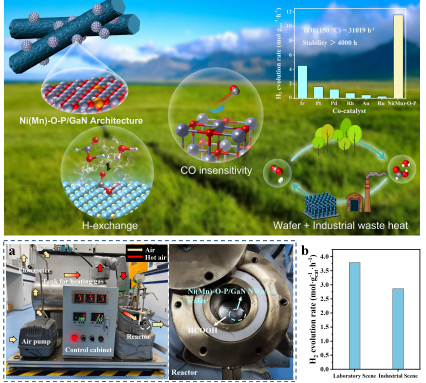
This study constructed a high-efficiency catalytic system using one-dimensional GaN nanowires as the support and Mn-doped Ni-O-P nanoclusters as the active component. The catalyst demonstrated outstanding formic acid performance at 150oC: the introduction of P and doping of Mn enhanced the hydrogen production rate to 29.92 mol·gcat-1·h-1, with a TOF (Turnover Frequency) of 31019.2 h-1, surpassing most noble-metal catalysts. The system maintained stable activity, with approximately 10% decrease after 4000 hours of operation. Furthermore, in-situ spectroscopy, mass spectrometry, and isotope labeling studies revealed a new mechanism by which trace water promotes formic acid dehydrogenation: the adsorbed *OH formed by the dissociation of water at the interface participates in the H-exchange process, stabilizing the key HCOO* intermediate and activating reactant molecules, thereby significantly improving dehydrogenation selectivity and inhibiting side reactions. DFT (Density Functional Theory) calculations further confirmed that this mechanism can reduce the reaction energy barrier and alter the rate-determining step. The design of an industrial prototype and simulation analysis of steam turbine power generation scenarios verified the technical feasibility of this system for formic acid hydrogen production driven by low-grade industrial waste heat. This research not only developed a noble-metal-free heterogeneous catalytic system with long service life, excellent anti-coking, and anti-CO poisoning properties, breaking through the limitations of traditional noble-metal catalysts in terms of cost and stability, but also provided a new technical pathway for in-situ hydrogen production from liquid hydrogen carriers using industrial waste heat. It can meet the demands of diverse hydrogen application scenarios (such as transportation, power generation, chemical industry, and metallurgy) and contribute to the achievement of the carbon neutrality goal.
This research was supported by the National Key Research and Development Program of China (Key Special Project on Hydrogen Energy Technology), the National Overseas High-Level Talents Program for Young Scholars, the National Natural Science Foundation of China (General Program), and the Shanghai Basic Research Special Zone Program.
The research team led by Baowen Zhou is focused on smart energy devices-systems-solutions for carbon neutrality, conducting research in fields such as solar refining/artificial photosynthesis, green hydrogen and renewable fuels, next-generation battery technologies, waste resource utilization, and AI+energy catalysis. Their research findings have been published in prestigious journals including Nat. Catal., Nat. Photonics., and PNAS.
Paper link: https://www.nature.com/articles/s41467-025-67895-y

Shanghai Jiao Tong University
Address: 800 Dongchuan Road, Shanghai
200240