
News
News
A research team led by Professor Fei Qi from School of Mechanical Engineering, SJTU, in collaboration with researchers from the University of Science and Technology of China (USTC), has made a significant breakthrough in understanding the microscopic reaction dynamics of ethanol steam reforming, a promising route for sustainable hydrogen production. The study, published in Nature Communications, identifies vinyloxy radicals (CH2CHO) as critical intermediates in the Ni/La2O3-catalyzed process, challenging long-held assumptions in the field.
Ethanol steam reforming offers an attractive pathway to produce hydrogen from biomass resources, but its complex reaction network has hindered catalyst optimization. The scientific community has long debated the identity of the C2H3O radical intermediate; while the acetyl radical (CH3CO) is widely assumed to dominate due to its thermodynamic stability, direct experimental evidence remains elusive.
Using synchrotron-based vacuum ultraviolet photoionization molecular-beam mass spectrometry (SVUV-PI-MBMS), the team directly detected gas-phase species over Ni/La2O3 catalysts across 473–1073 K. Combined with isotopic labeling, density functional theory calculations, and microkinetic modeling, they constructed a comprehensive reaction network that revealed a surprising finding: CH2CHO, not CH3CO, acts as the primary chain-propagating intermediate.
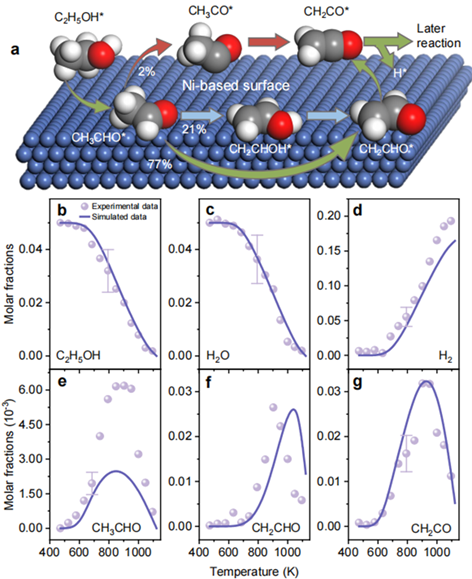
The photoionization efficiency curve showed characteristic onsets at 9.60 and 10.28 eV consistent with CH2CHO, while no signal appeared in the expected ionization range for CH3CO radicals. DFT calculations demonstrated that acetaldehyde preferentially undergoes β-H abstraction at the Ni–La2O3 interface due to geometric constraints, with microkinetic analysis quantifying that approximately 77% of acetaldehyde conversion proceeds through the CH2CHO pathway.
This discovery provides new mechanistic insights into La2O3's unique role in suppressing carbon deposition and byproduct formation. This multiscale approach—combining quantitative detection of intermediates with theoretical calculations and kinetic modeling—offers a powerful framework for elucidating mechanisms in complex catalytic systems involving reactive intermediates.
Co-first authors: Zaili Xiong (PhD. Student, SJTU) and Xiaokuan Ban (PhD. Student, USTC)
Paper link: https://www.nature.com/articles/s41467-025-67170-0

Shanghai Jiao Tong University
Address: 800 Dongchuan Road, Shanghai
200240